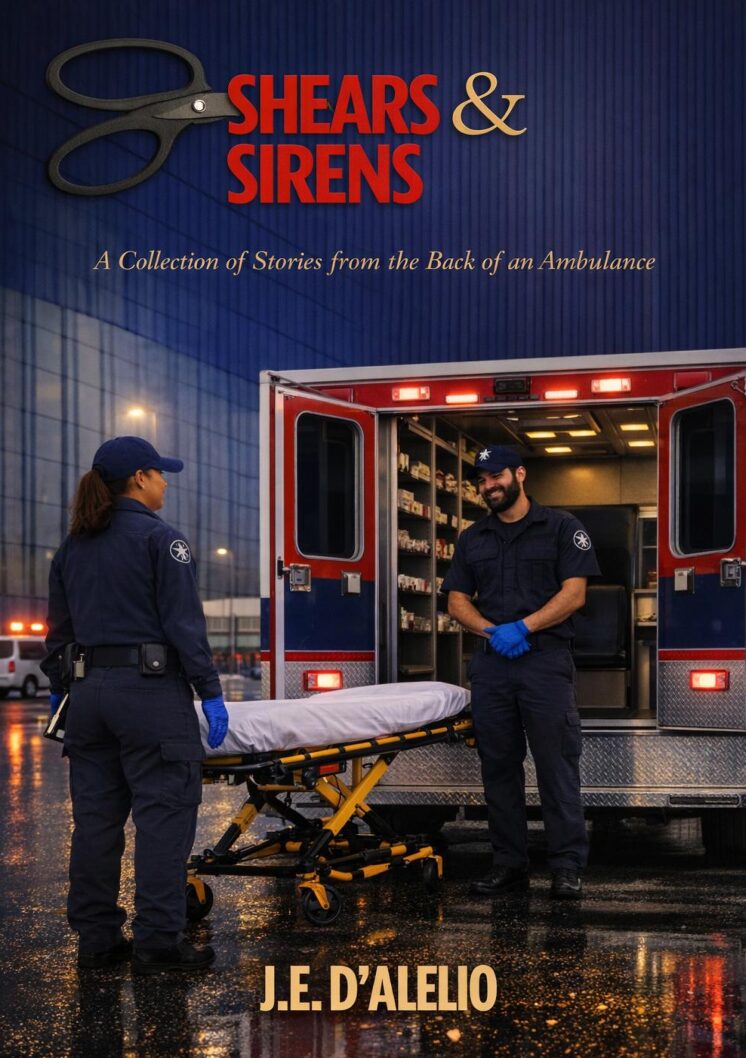
Writing What Persists After the Call
By J.E. D’Alelio
The work in emergency medicine is defined by sequence: dispatch, arrival, assessment, intervention, transport. Each step is documented, timed, and closed. The record reflects completion. It suggests resolution.
What persists rarely follows the same structure.
Shears and Sirens was written to examine the space between protocol and outcome—the interval in which decisions are made and direction is established long before documentation begins. These moments are not abstract. They are immediate, shaped by environment, perception, and pattern recognition developed over time.
In practice, the first assessment often carries disproportionate influence. Initial impressions can define the pace of care, the questions asked, and the interventions pursued. Subtle factors—tone, positioning, sequencing—become consequential, despite remaining largely unacknowledged.
This work does not attempt to reconstruct events into narrative form. It isolates them. Each passage reflects a condition rather than a story, emphasizing function over interpretation. The structure mirrors the professional environment itself: controlled, direct, and without unnecessary elaboration.
There is no singular theme beyond the work. The content moves through clinical encounters, procedural moments, and the quieter intervals that follow—periods where providers process experience without formal framework. These fragments, taken together, represent a system operating under continuous pressure, where repetition builds efficiency but also reinforces patterns that are not always examined.
Shears and Sirens does not assign resolution. It does not evaluate outcomes or correct behavior. Its purpose is narrower and more deliberate: to present the work as it occurs, without modification or expansion.
For those within emergency services, the material will be familiar in form and context. For those outside it, the writing offers a view into a profession often defined by its endpoints rather than the decisions that shape them.
The focus remains consistent throughout.
Not the report.
Not the outcome.
Only the work.
Read the Work
If you recognize the environment, you understand the weight of what is not written.
If you do not, this is where it becomes visible.
Get it here:
https://www.amazon.com/dp/B0H383GQH1
Leave a Reply