In emergency medical services, most missed calls are not the result of inadequate training, poor technical skill, or a failure to follow protocol. They occur in quieter ways—through decisions that feel reasonable in real time. A call appears straightforward, the patient presentation aligns with previous experience, and nothing immediately signals the need to look deeper. The assessment proceeds, but it narrows. What is lost is not the process itself, but its depth.
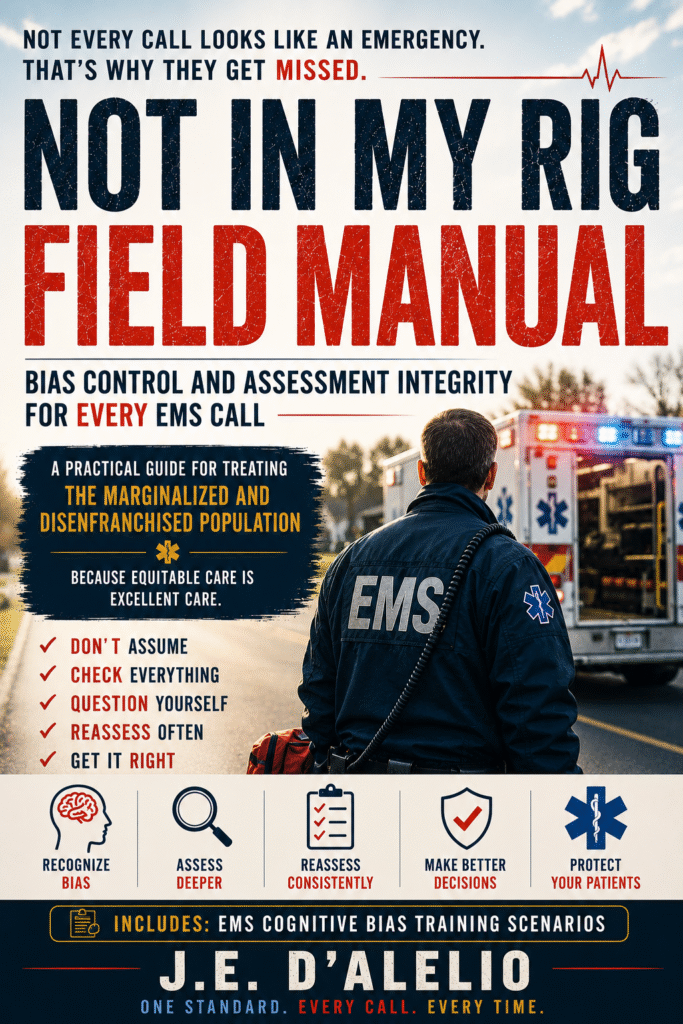
This is the central problem explored in Not in My Rig. The book does not challenge what providers know; it challenges when and how that knowledge is applied.
The reality of prehospital care is that assessments often begin before crews ever reach the patient. Dispatch notes, familiar addresses, and patient histories create an initial framework that shapes expectation. A frequent caller is assumed to present in a predictable way. A known location carries associations with certain types of complaints. These expectations are not inherently harmful—experience is built on pattern recognition—but they influence attention. By the time providers make patient contact, the range of possibilities may already be reduced.
The difficulty is that these early impressions rarely feel like assumptions. They feel like efficiency. They allow providers to move quickly, to prioritize effectively, and to manage high call volumes. In most cases, they work. However, when experience becomes a substitute for assessment rather than a guide to it, the risk is no longer visible. The provider does not consciously decide to perform a shorter or less thorough evaluation. Instead, the assessment simply stops once an explanation appears sufficient.
This is how calls are missed—not through dramatic failures, but through premature closure.
EMS culture reinforces this process in subtle ways. Alongside formal protocols exists an informal curriculum, one built through conversation, repetition, and shared experience. Providers hear the same language repeatedly: certain patients are predictable, certain complaints are routine, certain outcomes are already known before arrival. Over time, these ideas become normalized. They are not taught explicitly, but they are learned nonetheless, shaping how new clinicians interpret the work.
The danger is not that these beliefs are always incorrect. In many cases, they are rooted in real patterns. The danger lies in how readily those patterns become conclusions. A patient’s history, environment, or reputation begins to function as an explanation before the current assessment has been completed. When that happens, curiosity decreases. Fewer questions are asked. Subtle inconsistencies are not pursued. The call continues forward with a sense of resolution that has not yet been earned.
The cases providers remember most clearly often illustrate this gap. They are not the routine calls that follow expected trajectories, but the exceptions—the patient who did not match the pattern. The individual who appeared intoxicated but was hypoglycemic. The psychiatric presentation that concealed a medical emergency. The chronic complaint that represented an acute change. These moments persist precisely because they expose how easily confidence can outpace verification.
Not in My Rig is not primarily concerned with overt bias or unprofessional behavior. Most providers recognize those issues and actively avoid them. Instead, the book focuses on a quieter form of cognitive bias: the subtle shift that occurs when familiarity reduces curiosity and when confidence limits further investigation. A provider can remain professional, respectful, and technically proficient while still missing critical information if the assessment concludes too early.
The phrase “Not in my rig” is often used as a statement of standards, but in this context, it represents a different kind of commitment—one rooted in consistency rather than control. It is not about eliminating error entirely, but about maintaining the same level of assessment regardless of how routine a call appears. It is the decision not to allow patient history, environment, or prior experience to determine how thoroughly an evaluation is performed.
In practice, the change is smaller than it appears. It does not require new protocols or additional training. It requires a deliberate interruption of the automatic process—a brief pause in which the provider asks a simple question: What am I assuming right now? That moment creates space for reassessment. It forces the provider to distinguish between what has been observed and what has been inferred.
This distinction is critical because EMS rarely signals when something is being overlooked. There is no clear indicator that the assessment has narrowed too soon. The scene may remain calm, the patient cooperative, and the story coherent. The only difference between a complete call and an incomplete one may be a detail that was not explored.
The book ultimately reframes how providers think about routine work. The greatest risks are not always found in chaotic or high-acuity environments, where vigilance is naturally elevated. They are often found in the calls that feel controlled, familiar, and resolved. These are the situations where assumptions carry the greatest influence because nothing actively challenges them.
Not in My Rig argues that consistency—not speed, confidence, or even experience—is the defining feature of strong clinical practice. Providers do not eliminate mistakes by abandoning pattern recognition; they reduce them by verifying those patterns before accepting them. The difference between an accurate assessment and a missed one is often measured in seconds: a single question asked, a detail rechecked, a moment of doubt that allows the call to be seen again.
At its core, the book presents a straightforward premise. The most significant failures in patient care do not occur because providers did not know what to do. They occur because the call felt complete before it actually was.
Leave a Reply